
Dengie solar farm: wider public consultation planned for early 2027
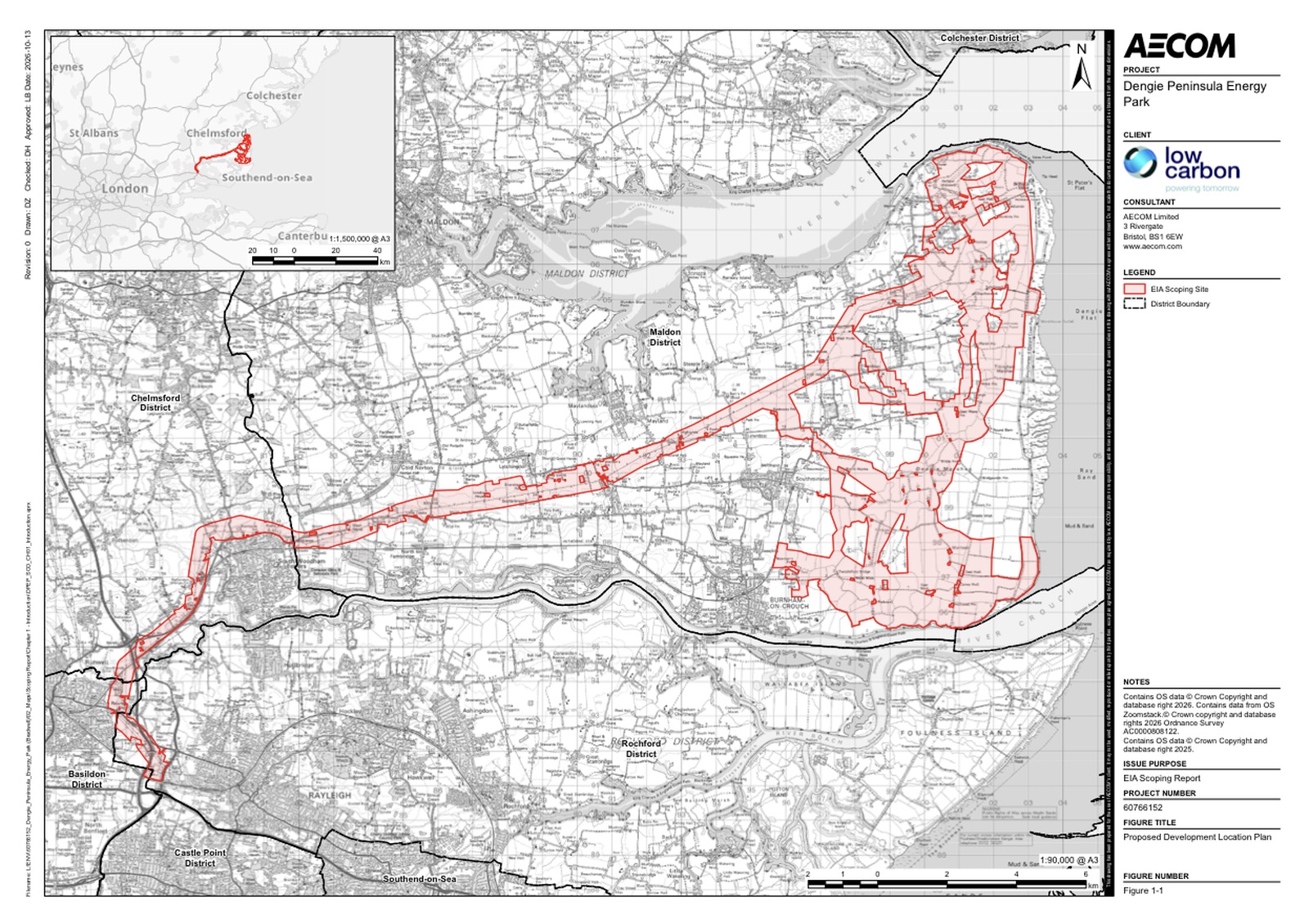
The sites run from near the closed Bradwell nuclear power station to Burnham-on-Crouch, passing Tillingham and Southminster. Together they cover 1,700 hectares, about the size of 2,400 football pitches, and Low Carbon describes the scheme as one of the biggest solar farms in the UK. Simon Morgan, the Conservative leader of Maldon District Council, estimates it would take up almost a third of the land on the peninsula.
Essex County Council's map of the area affected covers Bradwell Waterside and Mill End, and land around the edges of Southminster, Asheldham, Burnham and Tillingham.
What is planned
The project, called Dengie Peninsula Energy Park, would combine solar panels with battery storage and an on-site substation. Low Carbon says it could generate up to 1GW, or 1,000 megawatts, enough to meet the yearly electricity needs of about 250,000 homes, and would avoid up to 265,000 tonnes of carbon dioxide emissions a year.
The power would be carried to the National Grid's substation at Rayleigh along the existing overhead line from Bradwell, using pylons that once served the nuclear power station. Low Carbon already has a grid connection offer there. It is also keeping open a second option at the former Bradwell substation, although it has no offer for that yet.
The company says it chose the Dengie for its sunshine, its large flat fields and the grid links left behind by the power station. The scheme is being developed by Dengie Peninsula Energy Park Limited, part of Low Carbon, a renewable energy company founded in 2011.
Who decides
Because it would generate more than 100 megawatts, the scheme counts as a nationally significant infrastructure project and needs a development consent order. The Planning Inspectorate would examine any application, and the Energy Secretary, not Maldon District Council, would make the final decision. The council says it will still give planning and technical advice and speak up for local communities, working with Essex County Council.
What happens next
The plans are at an early stage. Low Carbon has asked the Planning Inspectorate to agree which environmental studies it must carry out, and Maldon District Council has until Tuesday 24 November to send its comments. The studies would look at the landscape and views, wildlife and habitats, the loss of farmland, construction traffic, new power lines, noise, effects on aircraft and glare from the panels. The council stresses this is not a vote on whether the park should go ahead.
Low Carbon plans a wider public consultation in early 2027 and aims to submit its application to the Planning Inspectorate by the end of that year. Essex County Council expects it in October 2027. If it is approved, the company's project website says building would start in 2030, the park would be fully running in early 2034, and it would have a working life of about 40 years.
The concerns
James Taylor, chairman of the Dengie Climate Action Partnership, told BBC News the scale had "slightly knocked people sideways", and said he was torn between backing renewable energy and worrying about wildlife. Roger Morland, chairman of Burnham Against Non-Sustainable Development, pointed to the area's international importance for wildlife and its protection as a Site of Special Scientific Interest.
Campaigners fear harm to a key bird migration route and to country roads while the park is built. Low Carbon says extensive bird surveys are under way, some building materials could arrive by boat, and reusing the old grid lines means less new infrastructure. Ed Perrin, its development director, argues that schemes on this scale are needed to meet the country's targets for cutting carbon.
Have your say
Low Carbon says it is still at an early stage and plans a wider public consultation in early 2027. Maldon District Council says residents will get another chance to comment then, before any application is made, and that its current comments on the environmental studies do not give permission to build.
The project team can be contacted on 0800 047 8766, by email at info@dengiepeninsulaenergypark.co.uk or through the feedback form on the project website. Documents submitted so far, including the environmental scoping report, are on the Planning Inspectorate's project pages.
Key points
- Maldon council must comment on the environmental studies by 24 November
- Ministers, not the council, will make the final decision
- Building could start in 2030 if the plan is approved, with full operation in early 2034
You may be interested in
- Heidi Alexander tours Stansted's bigger security hall and new solar farm on Transport Secretary visit Stansted · Sunday 8 November
- Plans emerge for 1GW solar and battery energy park on the Dengie Peninsula Bradwell-on-Sea · Friday 6 November
- Burnham-on-Crouch swimmers cross Channel in relay for Havens Hospices Burnham-on-Crouch · Thursday 19 November
- Essex oyster exports lost to Brexit could return under UK-EU deal West Mersea · Sunday 22 November
Earlier on this story: Plans emerge for 1GW solar and battery energy park on the Dengie Peninsula (Friday 6 November)
Also reported by
- Maldon District Council maldon.gov.uk ↗
- Dengie Peninsula Energy Park (Low Carbon) dengiepeninsulaenergypark.co.uk ↗
- Essex County Council essex.gov.uk ↗
- Gateway 97.8 (BBC Essex) gateway978.com ↗
This is a summary written by The Seax. The original reporting, quotes and images belong to BBC News and the other outlets listed. Spotted a mistake? Tell us.
Know more about this story, or have one of your own? Email news@theseax.com. Corrections to corrections@theseax.com.