
Brentwood School coach Gareth Stafford Bull likely abused pupils, review finds
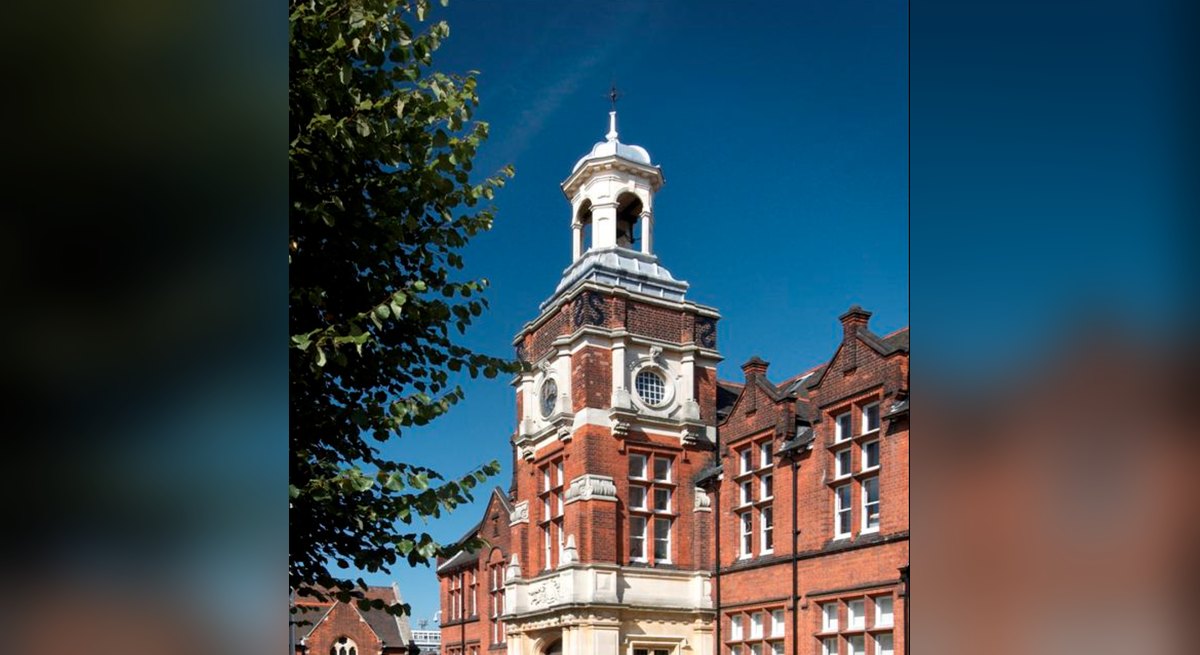
Warning: this story contains details of child sexual abuse that some readers may find distressing. Support lines are listed at the end.
The school's own independent review says the fencing coach probably harmed a number of boys through the 1980s and 1990s, and that former pupils who came forward years later were brushed off. British Fencing is now launching its own inquiry.
When a former pupil raised concerns about Bull with the school in 2008, the headmaster replied that he had seen no evidence, even though the school's own files recorded that police had found prima facie evidence against him in 1997.
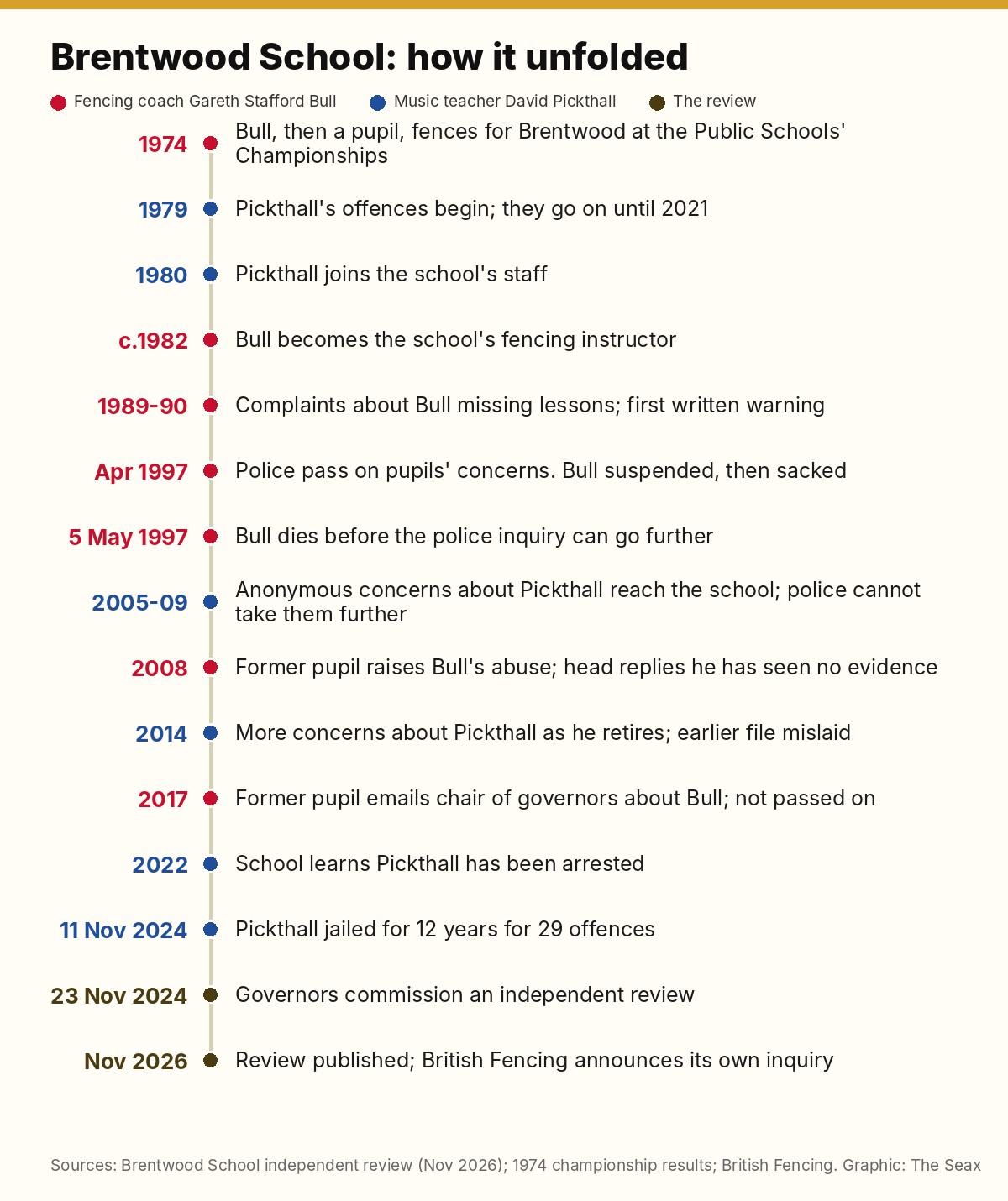
Gareth Stafford Bull was himself a Brentwood pupil, and came back as the school's fencing instructor in about 1982. Published results show he fenced for the school as a boy, finishing third in the boys' senior sabre at the 1974 Public Schools' Fencing Championships. The review says he also coached the England under-20 fencing team, and that former pupils told it he abused other boys while he was still a pupil and went on doing so throughout his time as a coach.
He was suspended and then sacked for gross misconduct in April 1997, after police told the school that pupils had raised concerns about him. He died in May 1997 before the police investigation could go further, so he never faced trial. The review's findings about him are made on the balance of probability, the standard used in civil cases, rather than the criminal standard of beyond reasonable doubt.
Who wrote the review
The findings come from the "Review into the abuse by David Pickthall of pupils and former pupils of Brentwood School", a 59-page report commissioned by the school's governing body and published on the school's website this month. It was led by two independent members. Louisa Spicer, who chaired it, is a former solicitor with more than 20 years' experience in employment law and human resources. Jane Foster (Sarre) is an independent safeguarding adviser, consultant and trainer who has led school safeguarding audits. They were supported by three governors who had no part in managing Pickthall: Bob McLintock, John Griffith-Jones and the Venerable Chris Burke. The Seax has read the full report.
The governors commissioned the review on 23 November 2024, days after Pickthall, the school's former director of music, was jailed. He admitted 29 offences against 19 male victims between 1979 and 2021, most of them his former pupils, and was sentenced to 12 years with a further four on extended licence. He was asked to take part in the review but declined. It began work in March 2025, and as well as Pickthall's abuse, its remit covered other historical allegations about former members of the school community. That is where the findings about the fencing coach appear.
The reviewers say the school kept virtually no records for the 1980s and 1990s, so they relied heavily on court transcripts and on accounts from former pupils and staff.
How it unfolded
What happened in 1997
The details of Bull's appointment are not in his personnel file, which is thin. Its first document is a complaint from the head of Brentwood Prep in May 1989 that he was unreliable and missed lessons. In 1990 the headmaster gave him a first written warning over his absences and an unpaid accommodation bill of £1,000, while praising his "tremendous success" as a coach and telling him the school was in his debt.
In April 1997 the headmaster wrote to the parents of pupils involved in fencing to tell them Bull had been suspended. A note on his file records that a small group of boys had come forward to a member of staff. The concerns included encouraging boys to shower after competitions and joining them. Governing body minutes from 21 April record that police enquiries, prompted by an anonymous call, had found prima facie evidence of indecent behaviour involving members of the school fencing team, particularly on trips away. By then Bull was missing from home, and the headmaster judged the evidence against him to be incontrovertible. He was dismissed the next day.
The headmaster gave police a list of pupils who had been taught by Bull, and officers interviewed them at the school. On 27 April more pupils who had contact with him were seen one by one in the headmaster's office. The brief notes kept from those meetings confirm that a number of pupils said Bull had suggested they shower with him. Bull died on 5 May 1997, and his death and the police investigation were reported in the national press.
What former pupils told the review
One former pupil told the review that Bull abused boys on what he called "an industrial scale", including intimate massages, coming into boys' rooms on residential trips, sexualised conversation and invasive questions about their sexuality. Bull travelled alone with pupils and sometimes shared rooms with them. They said he also befriended parents, visiting their homes and having dinner with them. One described him as effectively part of the staff although he was not a full-time employee, coming and going as he pleased, and said pupils talked about him only on a surface level. Contributors said staff must have heard rumours. The review says the full extent of his offending is not known and that more victim-survivors may come forward.
How the school handled later complaints
Former pupils contacted the school about Bull in 2008, 2017 and 2024. In 2008 a former fencer told the headmaster of the time, who had not been at the school while Bull worked there, that many of his contemporaries had been abused and had suffered mental and physical breakdowns, and asked what support the school had offered. The review says the headmaster's reply contradicts the evidence in Bull's own personnel file and in governing body minutes, and it found no sign of any follow-up.
In 2017 another former pupil emailed the chairman of governors to say Bull had abused him when they were both pupils, and was told to go to the police. The review has not seen the reply and does not know who sent it. It found no record that the email was passed to the headmaster, the safeguarding lead or the police, which it says was by then a failure to meet statutory guidance, and it describes the response to him as dismissive. The same man told the review that another former member of staff had set up a situation in which he felt obliged to shower with Bull. In 2024 a third former pupil told the school it had never held itself accountable for the number of pupils Bull abused.
The review concludes that police held prima facie evidence against Bull in 1997 and that, on the balance of probability, a number of pupils were harmed by him both when he was a pupil and while he was a coach at the school. It found no evidence that the school pursued the matter after his death or offered support to anyone affected, and that its later responses to former pupils were inadequate and lacked empathy. It says further investigation now is unlikely to change those findings.
Pickthall, and the school's culture
The review found no evidence that Pickthall and Bull worked together, but says the prestige both men brought, as a renowned musician and a fencing coach, may have made school leaders reluctant to believe concerns about them. Former pupils described Pickthall as godlike and bigger than the school, and one described the school of the mid-1980s to mid-1990s as having a culture of fear. Pupils told the review they did not report abuse because they feared not being believed or harming their chances in music. On Pickthall, the review found anonymous allegations in 2007, 2009 and 2014 were not properly investigated, and a misplaced personnel file meant earlier warnings were not seen.
The review also heard what it called credible accounts of abuse by other staff in the 1960s and 1970s, including harsh physical punishment, and of abuse by pupils. It says the staff named in those accounts have died or cannot be traced.
What the school says
In a foreword, the chairman of governors, Lord Black of Brentwood, who was a pupil at the school in the 1970s and early 1980s, offers a "deep, sincere and unreserved apology" to everyone abused in the school's past. He says the governors have accepted the report and all its recommendations, and that the school has learned the lessons. Nobody, he writes, will ever again hide behind the idea that it could not happen there, because it did.
Lord Black says safeguarding is now the first item of business whenever governors meet, and that the school has changed out of all recognition since Pickthall left in 2014. He points to inspections by the Independent Schools Inspectorate in 2019, 2022 and 2025, and to two independent safeguarding reviews the school commissioned in light of Pickthall's crimes, in 2022 and 2025. The review itself agrees that safeguarding at the school today is strong, well resourced and led from the top, and that pupils describe the school as happy and safe.
On its website, the school lists 17 designated safeguarding leads and deputies. It says every senior school pupil carries a card with the names of people they can talk to and the numbers of outside organisations, and that pupils can report a concern through an online platform called The Student Voice.
What happens next
The review makes recommendations that the school has accepted. They include publicly acknowledging the harm done by Pickthall, Bull, other adults and pupils, and accepting that the school failed to detect abuse during the 1980s, 1990s and 2000s; sharing the report with the Essex Safeguarding Children Board; sharing the findings about Bull with British Fencing and the British Olympic Committee; training staff and governors in how sex offenders groom children; and checking that no other complaints about current or former staff have been misfiled.
British Fencing said on Friday 20 November that it would commission its own independent safeguarding review into the role, if any, of the sport's governing body and its predecessor, the Amateur Fencing Association. The former pupil who wrote to the school in 2017 has asked, in his evidence to the review, whether British Fencing and the British Olympic Committee were told about Bull in 1997.
Outside the school, Bull coached at Wickford Fencing Club from 1979 to 1987, according to the club's history page, which lists him among its previous coaches. The review makes no findings about his time at the Wickford club.
About Brentwood School
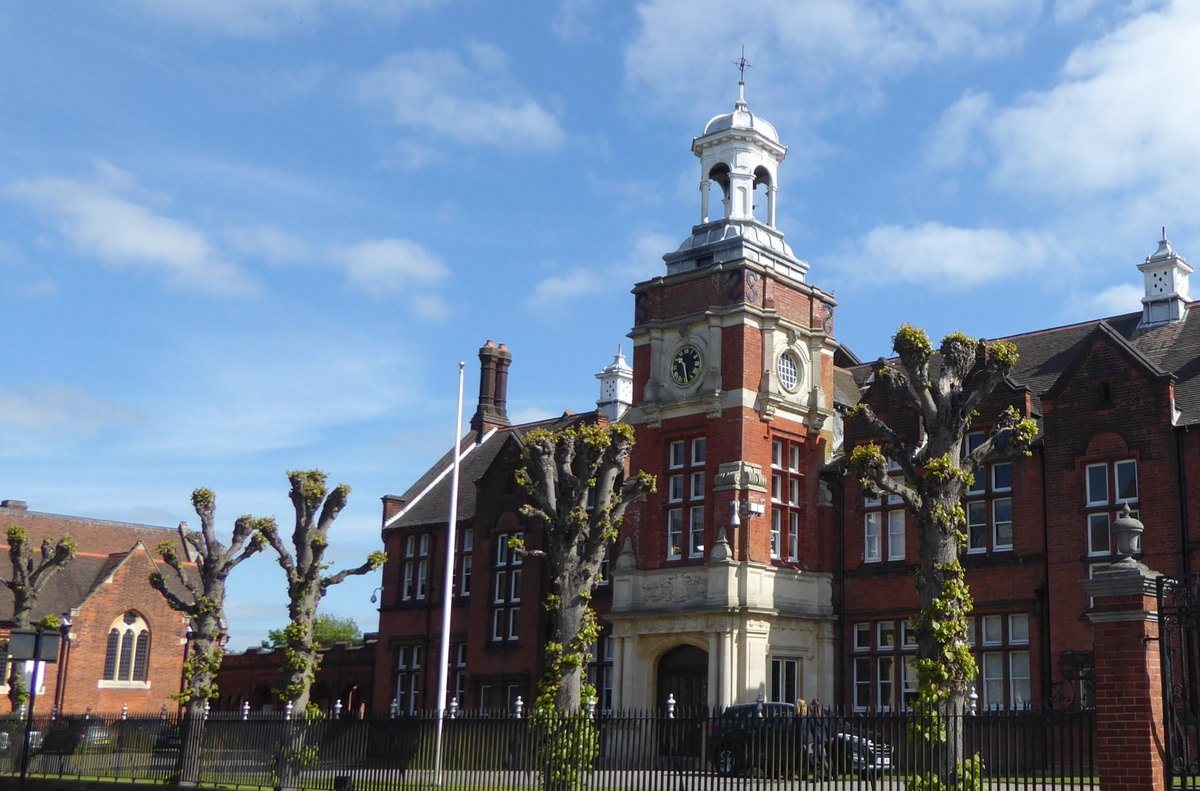
Brentwood School was founded in 1557 by Sir Antony Browne, a lawyer who later became one of England's most senior judges, and received its licence from Queen Mary on 5 July 1558. Its Tudor schoolroom, Old Big School, was built in 1568.
Today it is a private, fee-paying school and a registered charity, with more than 1,800 boys and girls aged 3 to 18 and boarding for older pupils. Boys and girls are taught together in the prep school and sixth form, but in separate classes from 11 to 16, an approach the school calls the Diamond Model.
Fees for 2026/27 are £30,204 a year for day pupils from Year 7 to the sixth form, including VAT, which has been charged on private school fees since January 2025. Full boarding costs £58,464 a year. Fees for younger pupils run from £16,500 a year for three-year-olds to £23,076 in Years 3 to 6. The school's charity had an income of £44.9 million in the year to August 2024, according to the Charity Commission.
Except where stated, everything in this story comes from the review. The 1974 result comes from published championship results, his Wickford coaching from the club's own website, details of the school's safeguarding team from its website, and British Fencing's plans from its statement on Friday. The school's history, fees and size come from its own website, the Independent Schools Council and the Independent Schools Yearbook, and its income from the Charity Commission register.
Where to get help
Brentwood School says victim-survivors can contact the headmaster or the chairman of governors in confidence. The review lists organisations that support adults abused in childhood: NAPAC on 0808 801 0331, Stop It Now on 0808 1000 900, SERICC on 01375 380609 and CARA Essex on 01206 769795. British Fencing has a form for reporting a safeguarding concern on its website. Samaritans is available any time on 116 123.
Key points
- Police had prima facie evidence against him in 1997
- A 2017 complaint to the chair of governors was never passed on
- Governors apologise and accept every recommendation
Also reported by
- British Fencing statement britishfencing.com ↗
- Wickford Fencing Club history wickfordfencingclub.co.uk ↗
- Picture of the school: Marathon, Geograph (CC BY-SA 2.0) geograph.org.uk ↗
This is original reporting by The Seax. Every figure was checked three times before publication. Spotted a mistake? Tell us.
Know more about this story, or have one of your own? Email news@theseax.com. Corrections to corrections@theseax.com.